UnitedHealthcare 2026 Health Trends Report
UnitedHealthcare unveils its annual report revealing key insights shaping employee benefit design and affordability strategies.
At UnitedHealthcare, insight and experience guide innovation and strategic decision-making. The 2026 Health Trends Report brings together comprehensive data, clinical knowledge and real-world perspective to provide greater transparency and clarity to the evolving health care landscape.
This report is designed to help employers, brokers and consultants better understand emerging trends and make more confident, informed benefits decisions. The insights presented draw from UnitedHealthcare's extensive self-funded and fully insured books of business, examining claims incurred between November 2024 and October 2025 and paid through January 2026.
While individual client results will vary based on specific demographics, plan design, geographic considerations and employee engagement levels, the trends shared in this report can be used directionally to influence and inform future benefits strategies. This work reflects UnitedHealthcare's sustained commitment to building a health system that is more transparent, more reliable and more closely aligned with what people truly need — one that improves health outcomes, strengthens trust and makes a meaningful difference in the lives of employees, their families and employers.
Trends shaping employee benefit design and affordability
Designed to help deliver more clarity and focus to the health benefits decisions employers face now and in the years ahead, the 2026 Health Trends Report from UnitedHealthcare examines 2025 claims data to identify the underlying drivers reshaping affordability, care patterns and workforce health.
Executive summary
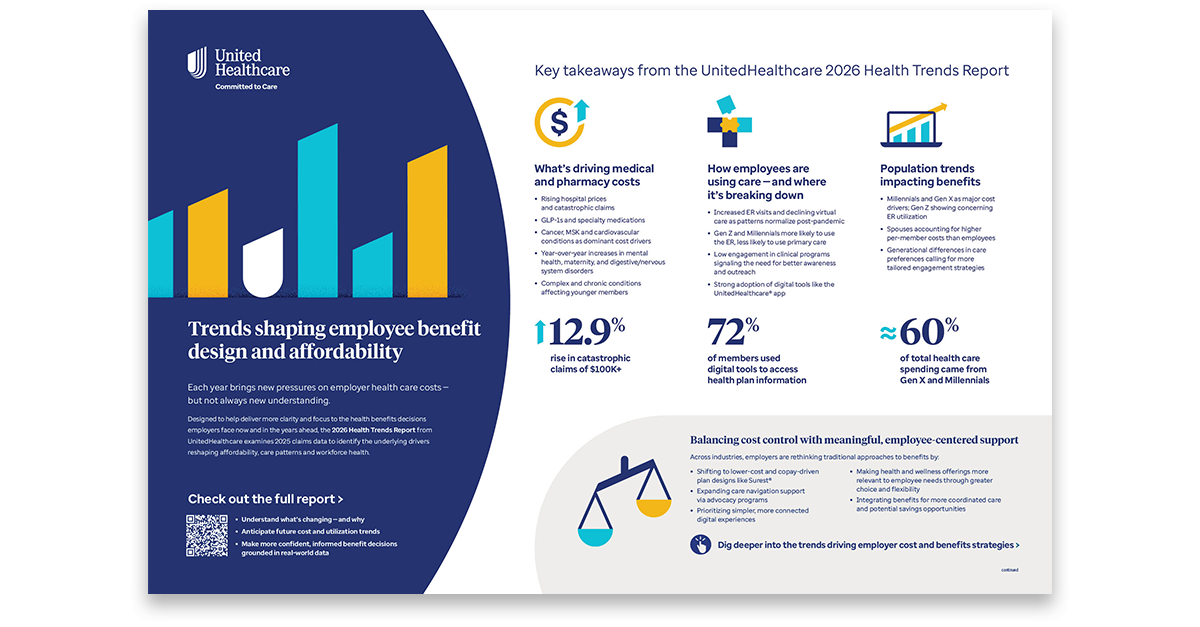
The 2026 Health Trends Report reveals accelerating health care costs driven by catastrophic claims, specialty medications and shifting utilization patterns. Medical trend is projected to grow at 8.5%,1 with pharmacy costs rising 11% in 2025,2 while the cost of claims over $100,000 increased 12.9% across UnitedHealthcare self-funded and fully insured books of business.3 In response, many UnitedHealthcare clients are moving away from high-deductible-only plans toward copay-driven plan designs and expanding advocacy solutions, care navigation and supplemental offerings to balance cost control with robust employee-centric benefits.
Medical and Pharmacy Cost Trends
Health care spending continues to outpace inflation, driven by rising hospital prices, catastrophic claims costing $100,000 or more (up 12.9% from 2024 to 2025),3 and pharmacy costs that rose 11% in 2025.2 Specialty medications now represent approximately 55% of total pharmacy benefit spend,4 with GLP-1s, new oncology therapies and gene therapies contributing significantly to this trend. Employers now spend $1 out of every $4 health care dollars on pharmacy,2 with some cell, gene and molecular therapy treatments costing up to $4M.5
These trends reinforce the importance of working with a carrier that is committed to reducing the cost of care at the system-level and exploring how different plan and network designs, such as copay-only plans like Surest®, can help, along with stop loss insurance to protect against high-cost claims.
Condition Cost Drivers
Per-member treatment costs rose across nearly all conditions from 2024 to 2025, with maternity costs increasing 11.7%, mental health increasing 10.9% and digestive system disorders increasing 10.5%. Neoplasms, which include both cancerous and non-cancerous tumors, musculoskeletal (MSK) disorders and circulatory or cardiovascular conditions remained the top cost drivers, with year-over-year cost increases ranging from 8.2% to 9.4%.3 Digestive disorders have particularly emerged due to rising obesity rates, expanded diagnostic testing and treatment availability, in addition to side effects from GLP-1 medications. Nervous system disorders are also driving up costs, which tend to be rare and complicated conditions to manage, but little can unfortunately be done to prevent these conditions.
Integrating medical, pharmacy and specialty benefits can help reduce costs associated with high-cost conditions, while clinical and care management programs that take a whole-person health approach can help improve employee well-being and outcomes.
Utilization Unpacked
Emergency room (ER) utilization increased 2.1% in 2025 while virtual care utilization dropped 16.1%, signaling a post-pandemic shift back to in-person care.3 Gen Z members showed particularly concerning patterns, relying more heavily on expensive ER services while being the least likely generation to use primary care. Digital advocacy and member engagement have become critical priorities for employers, with UnitedHealthcare data showing that members who actively use digital tools make more informed health care decisions — measured by a 5.3-point improvement in the Health Activation Index® score6 — which correlates directly to cost savings, prompting 44% of large employers to adopt or plan centralized digital health resource platforms.5 Targeted employee communications to help educate employees about appropriate site of care usage and drive engagement in digital tools and clinical programs can help right-size some of these utilization patterns and lower overall costs for employers and employees.
Population Insights
While Baby Boomers remain the most expensive generation, Millennials and Gen X are emerging as increasingly costly groups to manage, together accounting for approximately 60% of total health care spending as the majority of today's workforce.3 Millennials now visit the ER more frequently than any other generation including Baby Boomers, while Gen Z showed a 5.2% increase in ER visits.3 Spouses generated 36% higher per-member costs than employees, driven by older average age and higher usage across most major care categories.3 Tailoring communications to the preferences and health needs of different populations may help drive more effective health care utilization.
Benefits Strategy Shifts
Employers are moving away from offering high deductible health plans (HDHPs) as their only option, with one-third now offering copay-driven plan designs like Surest (up from 10% in 2023)3 to empower more informed, cost-effective health care choices. Employers are also expanding advocacy solutions, preventive drug lists (PDLs), affordability programs and prescription savings outreach to address rising pharmacy costs while considering increased stop loss coverage to protect against claims volatility. There is also growing interest in integrated solutions that simplify administration, women's health offerings and options that give employees more choice aligned with their individual needs.
Every day, UnitedHealthcare is turning data into actionable insights that fuel innovation and deliver greater health plan value to clients and members. This report is one of many examples of how UnitedHealthcare is committed to being a strategic carrier employers, brokers and consultants can trust.
 Share
Share

