How biosimilars are curbing specialty drug costs
Pharmacy costs are climbing. Biosimilars could be an employer’s special cure for helping to bend the spend curve.
- U.S. prescription drug spending surged 12.7% to $915B in 2025 and is on track to top $1T in 2026,1 with tariffs threatening to add another $51B a year.2
- Biosimilars are a proven cost deflator, generating $56B in cumulative savings since 2015 — about $20B in 2024 alone — with comparable clinical outcomes to originator drugs.4
- Employers can capture this value through formulary preference, plan design, employee education and switch incentives, with preferred biosimilar strategies driving 37% incremental drug savings.12
- UnitedHealthcare works to maximize the value of its biosimilar strategy by pairing targeted utilization management with carefully designed Prescription Drug Lists (PDLs) and specialty pharmacy partnerships to drive rapid, smooth transitions to the lowest-cost option.
Pharmacy spend shows no sign of slowing. In 2025, U.S. prescription drug spending surged 12.7% to $915B — one of the fastest growth rates in a couple of decades — and is on track to top $1T in 2026.1 Tariffs threaten to push costs even higher: A 25% tariff on pharmaceutical imports could add nearly $51B a year to U.S. drug costs.2 The good news is that biosimilars are widely regarded as a much-needed cost deflator for specialty medications and pharmacy spending. It’s no wonder that the U.S. biosimilars market is expected to grow 17.1% from 2025 to 2034.3
The Food and Drug Administration (FDA) approved the first biosimilar in 2015. Since then, these products have generated roughly $56B in cumulative savings for the U.S. health care system — with about $20B of that in 2024 alone.4 At last count, more than 90 biosimilars had received FDA approval, including 23 in 2025 — the highest annual total to date.5 Beyond their potential savings, biosimilars have gained adoption due to their comparable efficacy to the originator specialty drugs they’re modeled after, resulting in similar health outcomes.
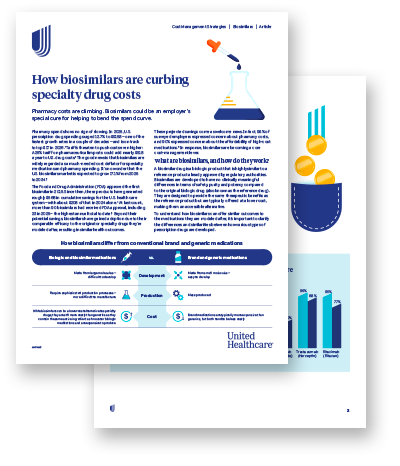
These projected savings come as welcome news. In fact, 95% of surveyed employers expressed concern about pharmacy costs, and 90% expressed concern about the affordability of high-cost medications.6 In response, biosimilars are becoming a core cost-management lever.
What are biosimilars, and how do they work?
A biosimilar drug is a biologic product that is highly similar to a reference product already approved by regulatory authorities. Biosimilars are developed to have no clinically meaningful differences in terms of safety, purity and potency compared to the original biologic drug (also known as the reference drug). They are designed to provide the same therapeutic benefits as the reference product but are typically offered at a lower cost, making them an accessible alternative.
To understand how biosimilars can offer similar outcomes to the medications they are modeled after, it’s important to clarify the differences and similarities between how various types of prescription drugs are developed.
How biosimilars differ from conventional brand and generic medications
| Biologic and biosimilar medications | vs. | Brand and generic medications |
| Made from large molecules — difficult to develop | Development | Made from small molecules — easy to develop |
| Require sophisticated production processes — more difficult to manufacture | Production | Mass-produced
|
| While biosimilars can be a lower-cost alternative to specialty drugs, they are still more costly than generics as they contain the same active ingredient as innovator biologic medications and are expensive to produce | Cost | Brand medications are typically more expensive than generics, but both tend to be less costly |
Taking a thoughtful approach to the adoption of biosimilars
Available biosimilars treat inflammatory conditions such as rheumatoid arthritis, as well as certain cancers, diabetes and other conditions.7 Like their generic counterparts, biosimilars offer a more affordable option to original biologic drugs and are typically dispensed through specialty pharmacies. Research suggests these alternatives may cost up to 40% less than the reference biologic.8
“In the coming years, we expect to see many biosimilars enter the market, as they are waiting in the wings for the patents to expire on their reference or innovator products,” says Susan Maddux, chief pharmacy officer for UnitedHealthcare Employer & Individual.
As the list of conditions that biosimilars address expands, more employees will be able to get the medications they need at a more affordable price. That matters to employers, since UnitedHealthcare data shows that specialty medications account for 55% of total pharmacy spending.9
37%
incremental drug savings for preferred products with biosimilar strategies12
Take Humira, a blockbuster prescription that generates billions of dollars in annual sales, prescribed to millions of people living with serious inflammatory conditions.10 With a monthly list price in the thousands, Humira may be cost-prohibitive for many employees.11 But with several biosimilar equivalents now on the market, competition is helping drive down the cost of these expensive treatments and make them more accessible.
Because clinical health outcomes are similar between biosimilars and their biologic innovators, medication costs can significantly influence treatment decision-making.
$1.92
per member per month (PMPM) prescription drug savings with biosimilar strategies versus average cost and utilization13
“At UnitedHealthcare, our philosophy is to select the most clinically appropriate therapies that provide the lowest net cost to our members, whether that includes coverage for biosimilars, the innovator drug or a combination of the two,” Maddux says.
Recognizing the role biosimilars may play in the future of health care and the cost of care, UnitedHealthcare has added biosimilars for Humira and Stelara, among others, to its standard PDLs. UnitedHealthcare continues to monitor market dynamics and advocate for more accessible prescription drug prices.
“Our objective at UnitedHealthcare is to ensure that manufacturers are incentivized to continue to discover and develop new medicines that treat complex diseases,” adds Maddux. “The idea is that, by supporting competition, we can help lower net costs for employers as well as out-of-pocket costs for employees.”
4 tips to help employers maximize savings
With the growing popularity of biosimilars and the potentially significant savings they present, it’s important for employers to make the most of this opportunity to lower costs for their employees and for their bottom line.
While carriers decide which biosimilars to cover and providers decide which prescriptions are most appropriate for employees, employers can take certain steps to help get more value from biosimilars — for their organizations and their employees:
- Work with insurance carriers and pharmacy benefit managers (PBMs) to understand their position on biosimilars, including which medications they cover and opportunities for potential savings
- Invest in health plan designs that include biosimilars in their medical and pharmacy offerings, with strategies that incorporate these medications into employees’ existing treatment plans
- Map out a communication plan to educate employees on the differences among biosimilars, brand-name medications and generics — and the impact of each type on costs and outcomes
- Offer eligible employees incentives to switch from a reference drug to a biosimilar when available
Speed and effectiveness define the UnitedHealthcare biosimilar strategy
While the industry broadly treats biosimilars as having comparable efficacy and safety, UnitedHealthcare pairs targeted utilization management with carefully designed PDLs and specialty pharmacy partnerships. This approach helps drive rapid, smooth transitions to the lowest-cost option.
The result shows up in the data: The preferred biosimilar market share for UnitedHealthcare consistently outpaces the industry average. Among self-funded employers, biosimilars to Stelara — a drug for autoimmune conditions — now hold 98% market share. Across its preferred portfolio, this approach translates to roughly 37% incremental prescription drug savings12 and about $1.92 PMPM in savings compared with average cost and utilization.13
 Share
Share

