White paper: A whole-person approach to employee benefits
Taking a whole‑person approach to benefits can set employers apart and drive healthier, more satisfied and productive teams.
- Whole-person benefits deliver measurable competitive advantages: Organizations implementing integrated health strategies saw a 67% improvement in employee satisfaction, 17% boost in retention and 6% increase in productivity.1
- Traditional benefits offered in isolation may lead to missed savings and health improvement opportunities: Addressing only some aspects of employee health may inadvertently contribute to suboptimal health outcomes and higher costs.
- Integration is key to maximizing value: Bundling medical, pharmacy, behavioral health, specialty, financial and wellness benefits can help enable holistic health management across benefits for the potential of lower costs and healthier, more productive workforces.
“Whole-person health” isn’t a buzzword — it’s a business imperative. Physical health, mental wellness, emotional resilience and financial stability don’t exist in silos. They’re interconnected and can impact employee well-being and performance.
Employers that offer just traditional benefits may not realize that addressing only some aspects of employee health and well-being may not only make their benefits package less competitive but also inadvertently contribute to suboptimal health outcomes and higher costs.
When it comes to a whole-person approach to benefits, data tells a compelling story. Strategies that support whole-person health have proven to deliver measurable results: 67% improvement in employee satisfaction, 17% boost in retention and 6% increase in productivity.1 These aren’t marginal gains; they’re competitive advantages.
This becomes particularly important in light of another recent study: With only 25% of employees planning long-term tenure and 34% actively job-hunting in 2026, the potential cost of turnover across the U.S. workforce could reach $1.3T to $5.1T. 3 Investing in benefits, however, may help mitigate this velocity of turnover.
And while there may be upfront costs to enhancing a benefits package, the investment can pay dividends through improved health outcomes and productivity. That ROI may be even greater for employers that purchase their benefits and coverages through one carrier because it can enable more connected care experiences and streamline procurement, billing and broader benefits administration.
This white paper provides direction employers, brokers and consultants can leverage to design benefits packages that aim to support the whole person, including:
- Quality medical plans that support diverse health needs
- Clinical and care management that addresses chronic or complex conditions
- Pharmacy benefits that can help manage drug spend
- Behavioral health solutions that offer a continuum of support based on severity of needs
- Specialty benefits that add to overall plan value
- Financial wellness benefits that can provide protection against unexpected costs and help achieve financial stability
- Wellness programs that support overall employee well-being
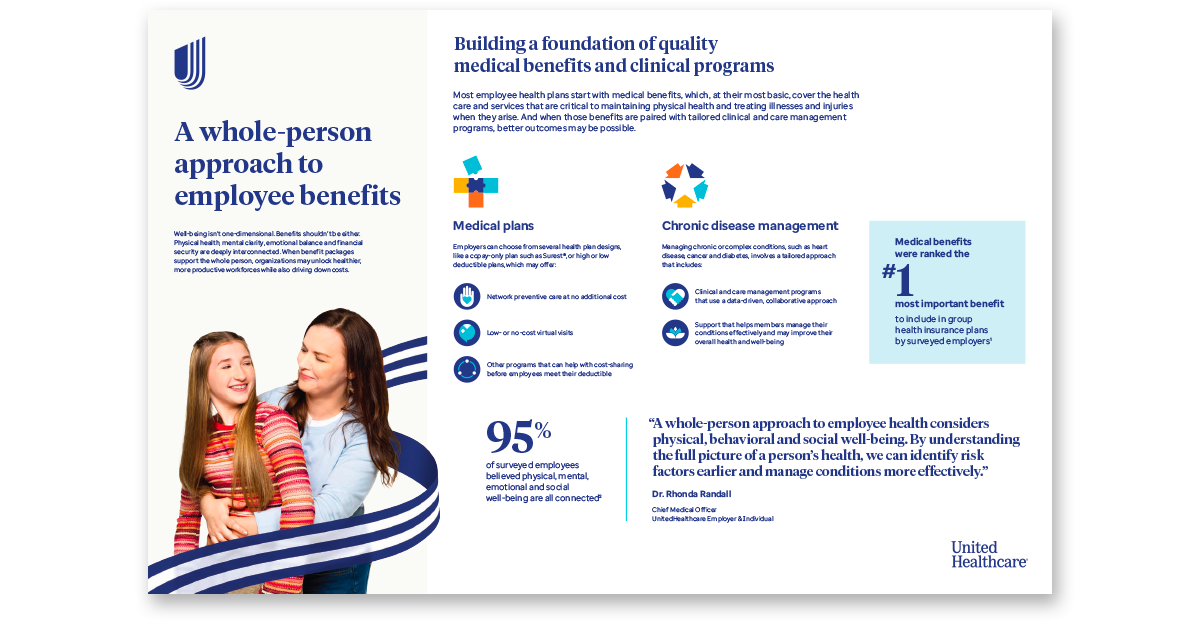
A whole-person approach to employee health benefits
Well-being isn’t one-dimensional. Benefits shouldn’t be either. Physical health, mental clarity, emotional balance and financial security are deeply interconnected. When benefit packages support the whole person, organizations may unlock healthier, more productive workforces while also driving down costs.
Quality medical plans that support diverse health needs
At its core, medical coverage should address the full continuum of basic health needs: preventive care, management of chronic conditions, urgent and emergency care and access to primary and specialty providers. Employer decisions around plan design — premiums, deductibles, coinsurance and copays — shape how costs are shared between the organization and its employees, which can influence how confidently and consistently individuals access care.
Selecting a medical plan today requires navigating a complex landscape of coverage options, delivery models and cost-control mechanisms. With medical service prices increasing year over year, many employers are reevaluating the value of broad, open-access networks. More organizations are shifting toward value-based provider networks or plans that emphasize or require engagement with a primary care provider (PCP). These models are designed to strengthen care coordination, improve health outcomes and offer members support to navigate and use the health system more effectively.
The market is also signaling movement away from high deductible health plans (HDHPs) as the sole or primary offering, with many employers reintroducing or expanding access to copay‑based plans. These options provide clearer, more predictable out‑of‑pocket costs, empowering employees to make more informed care decisions at the time of service rather than delaying or forgoing needed care due to financial uncertainty.
A strong plan does more than simply cover services — it proactively helps members find and receive care that is timely, appropriate and cost‑efficient. This includes:
- Coverage that reflects real health and care needs, from preventive to more episodic care
- Network depth and supportive tools that ensure employees can easily find quality, cost-efficient providers and facilities that also account for personal preferences
- Thoughtful cost-sharing that encourages appropriate utilization while maintaining affordability for employees at all income levels
- Integrated digital tools and support services designed to enhance navigation, provide price transparency and simplify the care experience
- Alignment with long-term cost sustainability, allowing employers to manage budgets while delivering meaningful value to their workforce
When employers invest in a quality medical plan, they may strengthen their ability to attract and retain top talent, reduce absenteeism, support overall employee wellbeing and mitigate long-term health care costs.
“In an increasingly competitive labor market, the medical plan is no longer a commodity — it is a strategic asset that shapes both organizational culture and workforce health outcomes.”
Medical plan and network design can impact everything from cost control and health outcomes to employee experience. Learn more ➜
Clinical and care management that addresses chronic or complex conditions
It’s also becoming increasingly important that medical plans have a clinical or care management component to help support employees impacted by a chronic or complex condition. Chronic diseases are the leading cause of illness, disability and death in America, accounting for $4.9T of the nation’s annual health care spend.5
Understanding the health profile of an employee population can help inform which clinical programs may be most beneficial to layer on top of medical plans — delivering more targeted, tailored support where it’s needed most. Addressing costly chronic conditions like heart disease, cancer and obesity requires looking at the whole person — from one’s lifestyle and behaviors to financial or other comorbidities an employee may be experiencing.
For example, managing diabetes may involve coordinating care across a member’s medical, pharmacy and behavioral health benefits — ensuring medication adherence, monitoring blood sugar levels and addressing stress or depression that can impact the condition. By working across multiple benefit types, clinical programs can address the interconnected factors that influence health outcomes, leading to more effective condition management and improved overall well-being.
“Clinical and care management programs are where whole-person health becomes real — by filling critical gaps in the system and surrounding members and their care teams with the support needed to address medical conditions alongside the social, behavioral and environmental factors that influence health outcomes and overall well-being.”
Addressing the top drivers of medical spend often requires strategies that take a whole-person health approach to condition management. Download these condition snapshots for more details ➜
Pharmacy benefits that can help manage drug spend
Medical plans are typically employers’ top priority, but pharmacy benefits are a close second. The reason is clear: Pharmacy costs represent one of the largest line items in employer budgets. This is often because so many conditions require pharmaceutical intervention.
Many employers are prioritizing efforts around managing specialty drug spend — and rightfully so considering about 55% of total pharmacy benefit spending is driven by specialty medications.7 These include strategies like evaluating how a carrier addresses biosimilars and GLP-1s or exploring stop loss coverage for gene therapies. But, beyond that, employers are seeking carriers with capabilities that can help better manage the spend of these drugs across benefits.
In many cases, whether a drug is covered under a member’s medical or pharmacy benefit can have massive cost implications. For instance, 60% of specialty drug spending typically falls under pharmacy benefits, while 40% falls under medical benefits — a division generally determined due to how the drugs are administered.8 Without a carrier that enables cross-benefit drug management, this split creates missed savings opportunities. Integrated benefits can help bridge that gap, determining the most appropriate and cost-effective coverage pathway for each medication or treatment.
The advantages extend beyond cost optimization. Integration enables simpler member experiences, more connected care and earlier identification of chronic or complex conditions. The data proves it: At UnitedHealthcare, 80% of clinical program referrals originated within pharmacy systems — catching health issues up to 44 days sooner than fragmented approaches.9
Employers operating with separate pharmacy and medical benefits may ultimately be leaving money on the table and improved health outcomes unrealized.
Above all, employers should consider working with a carrier that takes a strategic approach to pharmacy benefit management. The right carrier can support employers in the complex balance between providing employees access to necessary medications and maintaining budget sustainability. This means working with a carrier that offers data-driven insights, proactive formulary management and programs designed to optimize both clinical outcomes and costs.
With the right expertise and tools, employers can help ensure their workforce receives quality pharmacy benefits without compromising financial stability.
Integrated pharmacy and medical benefits can help lower costs, simplify experiences and improve the overall health of employees. Learn more ➜
Behavioral health solutions that offer a continuum of support based on severity of needs
The connection between mental and physical health runs deeper than many organizations realize. When an employee’s mental health goes unaddressed, what begins as a manageable concern can quickly escalate into a serious mental health condition — one that may eventually manifest as physical ailments requiring medical intervention. This progression creates a cascade effect that extends far beyond the individual.
The economic impact alone is staggering. Approximately 15% of working-age adults currently live with a mental health disorder, and depression and anxiety alone drain $1T from the global economy annually through lost productivity.10 These aren’t abstract statistics; they represent a significant challenge for employers navigating workforce performance and health care costs.
Despite growing awareness and improvements in reducing stigma, many employees are still wary of speaking up or seeking support. While 77% of surveyed U.S. employees said they view discussing mental health in the workplace as appropriate, 42% fear negative career repercussions if they do so.11 This disparity between acceptance and action reveals a troubling gap in workplace culture.
The consequences for employers are measurable and substantial. About 1 in 4 surveyed employees said they had considered resignation due to mental health concerns — a potential talent drain that may threaten organizational stability.11 And only 13% of employees said they share their struggles with managers or supervisors.11
Strategic benefits design offers a pathway forward. Organizations can begin by working with carriers that maintain expansive behavioral health networks — featuring diverse provider specialties, both in-person and virtual options — and offer access to a continuum of support based on varying severity levels. This can help organizations avoid unnecessary costs associated with utilization of higher-intensity services like talk therapy when lower-severity solutions like digital self-help tools would be effective.
“Adding virtual health options into our network designs ignited the demand for members to access care when and where they wanted. This prompted us to start on a path towards revolutionizing our entire digital ecosystem of offerings, which now include several digital and self-paced options that can effectively address low-acuity situations,” says Trevor Porath, vice president of behavioral health solutions for UnitedHealthcare Employer & Individual.
Some carriers now offer proactive assessment capabilities that determine care levels, helping ensure employees receive interventions matched to their specific needs while helping organizations avoid unnecessary costs associated with higher-intensity services when simpler solutions may suffice.
The most effective approach integrates behavioral health benefits with medical and pharmacy benefits under a single carrier. This unified structure creates interconnected systems and processes that address mental health needs comprehensively.
Stacie Grassmuck, director of behavioral health product and innovation for UnitedHealthcare Employer & Individual, explains: “It is typically the medical spend that increases when behavioral health is not addressed. When we work directly with members to get them into appropriate behavioral health treatment, employees are likely to see better health outcomes and lower overall medical costs.”
As behavioral health care needs continue to increase, strategies to drive more effective utilization and drive down spend are critical. Learn more ➜
Specialty benefits that add to overall plan value
What some organizations may overlook about dental, vision and hearing benefits is that they’re not “extra;” they’re essential benefits. The reason? An individual’s mouth, eyes and ears often serve as indicators of overall health and well-being:
- Gum disease can signal cardiovascular issues12 that, when left untreated, may quickly compound into more serious and costly issues for both employees and employers. In fact, over $45B in productivity vanishes every year in the U.S. due to untreated dental disease.13
- Routine eye exams can detect up to 20 diseases — diabetes, stroke, certain cancers — often before symptoms appear elsewhere.14 And vision loss doesn’t just blur the world; it can reshape a person’s mental state, with studies linking it to increased loneliness, social isolation and anxiety.15
- Hearing loss can also be a sign of elevated dementia risk, sleep apnea and balance issues.16
When employers bundle specialty with their medical and other core benefits, the combined data can enable more holistic management of their employees’ health and well-being, along with an enhanced administrative and clinical experience that may lead to better outcomes and lower costs.17
“Dental, vision, and hearing benefits are more than preventive care — they’re vital indicators of overall health. When we bring these benefits together under one carrier, we reduce administrative burden for employers while enabling the interconnected care that drives real health outcomes. Integration isn’t just simpler, it’s smarter.”
Bundling dental, vision, hearing and medical benefits unlocks analytics that may help optimize costs, coordinate care and improve efficiency. Learn more ➜
Financial wellness benefits that can provide protection against unexpected costs and help achieve financial stability
More than half of U.S. adults lack sufficient savings to cover an unexpected $1,000 expense.18 This financial vulnerability extends beyond personal finances and can affect their mental health, productivity and focus at work,19 especially in the wake of rising health care costs, which may be adding further stress. In fact, U.S. employees spend more than 8 hours a week managing personal finances, with half of that occurring during work hours.20 The cumulative effect creates a workforce operating under persistent financial stress, impacting both performance and overall well-being.
Employer awareness of this issue has grown substantially. Nearly half — 48% — now rate their concern about employees’ financial wellbeing at the highest levels (9 or 10 on a 10-point scale), up from 39% in 2023.21 This increase reflects a growing recognition among organizations that employee financial health warrants strategic attention and support. Employers can offer their employees support in several ways, including through financial education resources via an Employee Assistance Program (EAP), for instance.
Employers can also look for:
- Plans designed to reduce out-of-pocket expenses and empower employees to make more informed decisions
- Digital tools designed to help members estimate costs for services and providers
- $0 copays for certain services like primary care, urgent care or virtual care visits
To help employees plan and save for health care costs, employers may consider including tax-advantaged health savings and spending accounts. Employers can go a step further with these accounts by contributing to or matching employee contributions, or providing employees with reimbursement accounts or dedicated funds that can be used toward premiums or qualified medical or health and wellness purchases.
And when employees experience unexpected added costs that accompany a major illness or accidental injury, financial protection benefits — such as accident protection, critical illness, hospital indemnity, disability or absence management and life insurance — can help provide employees additional financial security and relief.
“Financial stress and economic hardships impact the overall health and well-being of employees. Employers that include financial wellness support benefits in their health plan demonstrate a commitment to achieving whole-person health for their employees.”
More employees are turning to their employers for tools to help them manage their finances and achieve better overall financial wellness. Learn more ➜
Wellness programs that support overall employee well-being
Today’s workplace wellness programs have evolved far beyond basic gym memberships and fruit bowls in the break room to initiatives that touch every aspect of employee well-being, from mental health support and stress management to financial coaching and preventive health screenings. These programs create ripple effects throughout organizations, transforming workplace culture while simultaneously addressing the mounting health care costs that keep CFOs up at night.
Organizations implementing thoughtful wellness strategies have consistently seen remarkable returns on investment, with industry analyses showing:22
- 99% of surveyed HR leaders said wellness programs have increased employee productivity
- 91% said the cost of their health care benefits decreased as a result of their well-being program, up from 78% in 2023
- 89% said employees take fewer sick days as a result of their well-being program, up from 85% from the previous year
By encouraging healthier lifestyles and getting employees genuinely engaged in their well-being, organizations saw tangible reductions in medical claims, behavioral health costs, pharmacy expenses and more. When individuals participate in preventive health screenings, catch conditions like hypertension or prediabetes early, receive mental health support before burnout sets in and learn to manage stress effectively, they may avoid the expensive downstream consequences that drive health care costs skyward.
In fact, a recent survey indicated that despite cost pressures, employers want to increase or maintain investments in employee well-being.23 To support employers, some carriers are building integrated digital shops that allow employees to choose their own wellbeing resources and programs. These may be funded through lifestyle spending accounts, enabling employers to support a diverse, multigenerational workforce without the administrative burden or cost of managing multiple vendor contracts.
Wellness programs that incorporate incentives or rewards can also help encourage these behaviors, making these results more feasible. Employers that deploy their own internal wellness programs or communications, or establish wellness committees or champions, can contribute to creating a culture where employees feel like their overall health and well-being matters to their employer.
Healthy habits can make a big difference in an employee’s overall well-being — from preventing and managing chronic conditions to reducing stress. Explore the characteristics of effective wellness programs ➜
 Share
Share

