Lehigh Valley Health Network
Lehigh Valley Health Network refused to counter our last proposal and allowed our commercial contract to expire, as of April 26
Despite our repeated efforts to reach an agreement, Lehigh Valley Health Network (LVHN) chose to disrupt Pennsylvanians’ access to the health system. As a result, LVHN’s hospitals, facilities and its physicians are now out of network for UnitedHealthcare employer-sponsored commercial plans, as of April 26.
Important reminders:
- Network access to Jefferson Health’s legacy hospitals, facilities and its physicians is not impacted by this change
- People enrolled in UnitedHealthcare Medicare Advantage Institutional Special Needs Plans (I-SNP) have network access to the entire Jefferson Health System, including LVHN’s hospitals, and facilities and its physicians.
Our goal was to reach an agreement that was affordable for people and employers while providing continued, uninterrupted network access to LVHN. We recently delivered a proposal that would ensure the health system continues to be reimbursed at market-competitive rates. LVHN refused to counter and maintained its demands for a more than 20% price hike in one year, which would make it significantly more expensive than the average cost of all other hospitals in our network throughout eastern Pennsylvania.
While we remain committed to continued discussions, our primary focus at this time is providing people access to the care they need through either continuity of care or a smooth transition to another provider, as appropriate.
As we move forward, we want to provide the following information to you:
People in active or ongoing treatment for a serious or complex condition with an LVHN provider or at an LVHN hospital at the time they left our network are eligible for continuity of care
Continuity of care allows people to continue accessing care with their provider at in-network costs for a period of time after they leave our network. Examples of conditions that would be eligible for continuity of care include but are not limited to the following:
- People in active treatment for cancer;
- Women who are pregnant
Please call the number on your health plan ID card for more information regarding continuity of care, including assistance applying for it. Our dedicated team of advocates are ready to assist you with all your health care needs.
You continue to have access to a broad network of providers throughout the Lehigh Valley market and eastern Pennsylvania, including St. Luke’s University Health Network (SLUHN), Geisinger Health System as well as many others
We recently reached a multi-year agreement with SLUHN. The agreement provides continued, uninterrupted network access to SLUHN’s hospitals, facilities and its physicians.
SLUHN has established a dedicated phone number at 484-526-4440 for UnitedHealthcare members to call and schedule an appointment with an SLUHN provider.
UnitedHealthcare members with questions or in need of assistance finding alternative providers in their area can also call the number on their health plan ID card. They can also use the provider directory at myuhc.com to search for alternative hospitals and physicians in their area.
This negotiation only impacts LVHN’s hospitals, facilities and its physicians
Network access to Jefferson Health’s legacy hospitals, facilities and its physicians is not impacted for people enrolled in UnitedHealthcare employer-sponsored commercial plans, Medicare Advantage plans or Medicaid plans. The following hospitals continue to remain in our network on and after April 26:
North Region
- Einstein Medical Center Montgomery
- Jefferson Abington Hospital
- Jefferson Bucks Hospital
- Jefferson Frankford Hospital
- Jefferson Lansdale Hospital
- Jefferson Torresdale Hospital
Central Region
- Einstein Medical Center Elkins Park
- Einstein Medical Center Philadelphia
- Jefferson Hospital for Neuroscience
- Jefferson Methodist Hospital
- Magee Rehabilitation Hospital
- Moss Rehab
- Thomas Jefferson University Hospital
East Region
- Jefferson Cherry Hill Hospital
- Jefferson Stratford Hospital
- Jefferson Washington Township Hospital
We know people are rightfully concerned that LVHN chose to leave our network. We want to reassure you we are doing everything we can to reach an agreement and will remain at the negotiating table as long as it takes to renew our relationship. However, we need LVHN to share in our commitment to reach an agreement that’s affordable for the people we collectively serve.
Lehigh Valley Health Network (LVHN) issued a notice to end our contract and is demanding a more than 20% price hike in one year
We are actively negotiating with LVHN to renew our network relationship for people enrolled in UnitedHealthcare employer-sponsored commercial plans and the Veteran Affairs Community Care Network (VACCN). Our goal is to reach an agreement that is affordable for Pennsylvanians and employers while maintaining continued, uninterrupted network access to the health system.
In the event we are unable to reach an agreement, most LVHN facilities and providers would be out of network for people enrolled in employer-sponsored commercial plans and VACCN, beginning April 26, 2026. Please see the separate FAQs for additional details as some dates vary by the provider location.
A small number of LVHN providers also participate in our Medicaid plans, including the Children’s Health Insurance Program (CHIP). The dates these facilities would be out of network, including whether they’d be impacted by our negotiation, are outlined in the FAQs.
LVHN has chosen to leave our Medicare Advantage network, beginning Jan. 26, 2026
Most LVHN providers will no longer participate in our Medicare Advantage network following the health system’s decision to end our contract, effective Jan. 26. As a result, LVHN will be out of network for people enrolled in UnitedHealthcare Medicare Advantage plans, including Individual, Dual Special Needs Plans (D-SNP) and Group Retiree plans, beginning Jan. 26, 2026.
Please see the separate FAQs for additional details as some dates vary by the provider location.

LVHN’s hospitals are among the most expensive in eastern Pennsylvania, yet the health system is demanding a more than 20% price hike in one year
Employers and families throughout Pennsylvania are already struggling to afford skyrocketing health care costs. The leading driver of these increases are the prices hospitals charge—such as LVHN—which is seeking exorbitant price hikes.
LVHN’s proposal would significantly increase what Pennsylvanians pay for care, adding even more financial strain for people and employers during challenging economic times.
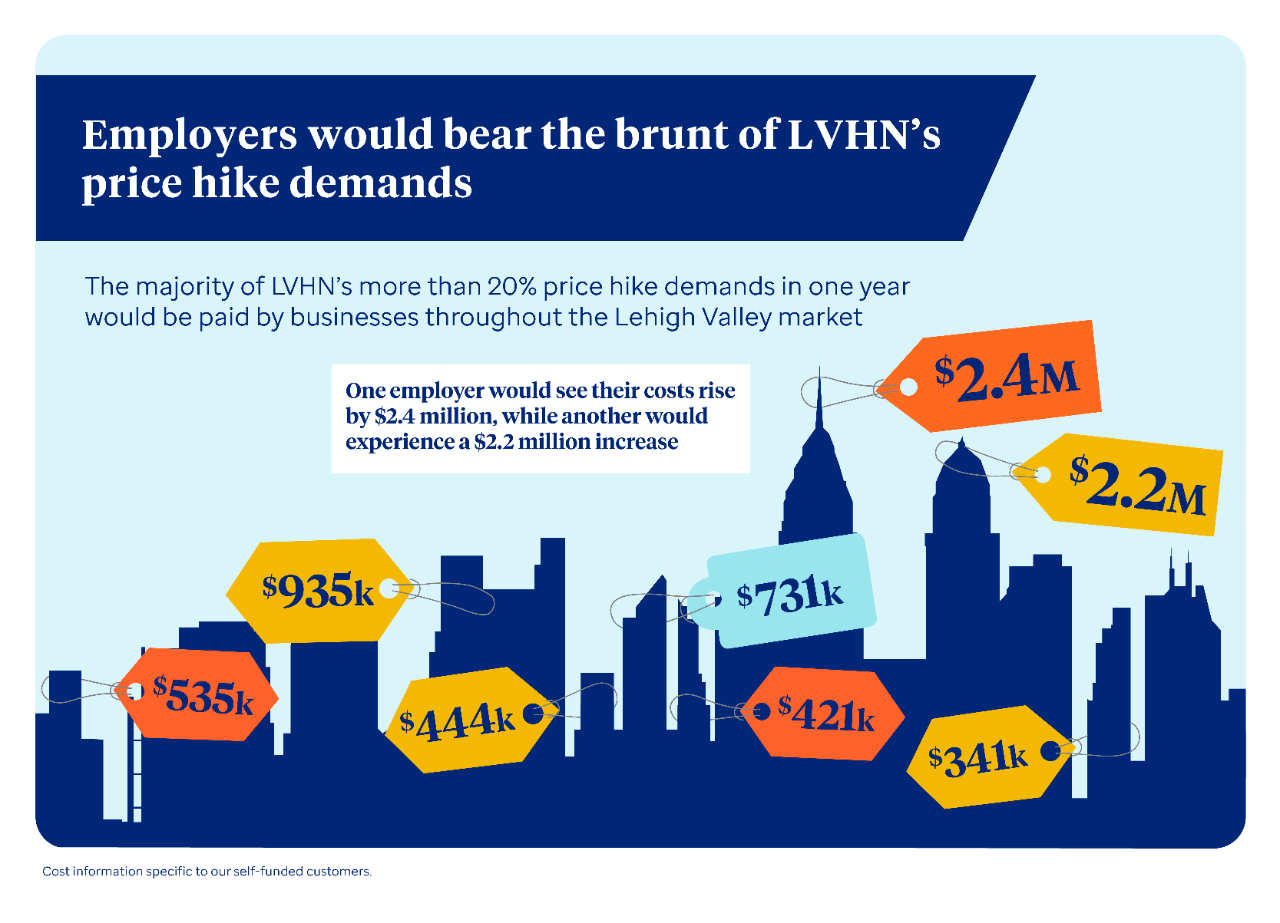
The majority of the price hike demands LVHN is seeking would come out of the budgets of self-funded employers
The majority of the rate increases LVHN is seeking would come out of the budgets of Pennsylvania employers. More than 80% of our members throughout eastern Pennsylvania are enrolled in ASO (self-funded) commercial plans, meaning their employers pay the cost of their employees’ medical bills themselves.
Agreeing to LVHN’s demands for a more than 20% price hike would mean these employers have less money available to pay salaries, invest in new technologies or help grow the business. These companies are also faced with difficult decisions about benefits and costs, often leaving them with no other choice than to pass a portion of these cost increases to their employees, resulting in higher deductibles, out-of-pocket expenses, and employee contributions.
Facts you should know

We will remain at the negotiating table as long as it takes to reach an agreement that is affordable for consumers and employers
We know the relationship between people and their doctors is deeply personal and important. We are doing everything we can to reach an agreement and we will remain at the negotiating table as long as it takes. However, we need LVHN to work with us toward an agreement that is affordable and sustainable for the people and local companies we serve.