The workforce is getting older: Implications for employers
Employers are designing benefit packages that accommodate aging employees who are staying in the workforce longer.
The American workforce is in the midst of a generational shift, and it is showing no signs of slowing down. Nearly 38M Americans ages 55 and older were employed as of early 2026,1 and workers 65 and older now represent the fastest-growing segment of the U.S. workforce, with their numbers more than doubling over the past 30 years.2 Driving this trend are longer life expectancies, evolving financialrealities and a growing desire for “a sense of purpose” — with nearly 4 in 10 workers today expecting to retire at age 70 or later, or not at all.3
The result is a workforce that is more multigenerational than at any previous point in history — spanning Generation Z, Millennials, Generation X and Baby Boomers, with more than 7 decades of combined life experience represented.4 By 2030, all Baby Boomers will be 65 or older, and, for most employers, the older segment of their employee population will largely consist of Gen Xers who will be between the ages of 50 and 65. Meanwhile, the share of workers aged 65 and older continues to climb, reaching 19.5% in 2024 and projected to grow further through 2034.5
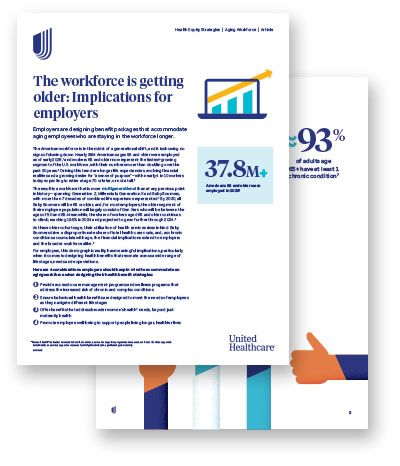
As these older cohorts age, their utilization of health services rises in kind. Baby Boomers drive a disproportionate share of total health care costs, and, as chronic conditions accumulate with age, the financial implications extend to employers and the broader workforce alike.6 For employers, this demographic reality has meaningful implications, particularly when it comes to designing health benefits that resonate across a wide range of life stages, needs and expectations.
37.8M+
Americans 55 and older were employed in 20261
Here are 4 considerations employers should keep in mind to accommodate an aging workforce when designing their health benefit strategies:
- Provide access to care management programs and wellness programs that address the increased risk of chronic and complex conditions
- Ensure behavioral health benefits are designed to meet the needs of employees as they navigate different life stages
- Offer benefits that address broader women’s health* needs, beyond just maternity health
- Promote employee well-being to support people living longer, healthier lives
1. Provide access to care management and wellness programs
93%
of adults age 65+ have at least 1 chronic condition7
Nearly 93% of adults 65 and older are managing at least 1 chronic condition, and 79% are navigating 2 or more simultaneously.7 For employers, the downstream impact is significant: Cancer, musculoskeletal (MSK) conditions and circulatory (cardiovascular) disorders consistently rank among the top 3 drivers of health care costs across employee populations — especially for those between the ages 50 to 59.8
What makes this particularly urgent is that these challenges do not emerge suddenly at 65; they build over time and significantly in the mid-life years. As the majority of Millennials approach or enter this window, employers have a critical and time-sensitive opportunity to get ahead of these trends rather than react to them.
The good news: Proactive plan design can make a meaningful difference. Benefits that incorporate robust care management and clinical programs can help employees prevent and manage chronic conditions earlier, supporting better health outcomes while keeping costs in check for everyone.
For instance, UHC Hub®, a portfolio of selected vendors that employers can choose from to complement existing offerings, provides a variety of lifestyle and well-being offerings that can help support employees as they age.
2. Ensure behavioral health benefits are designed to help employees in different life stages
While it is widely assumed that behavioral health conditions are primarily a concern among younger populations, the data tells a different story: Rates are climbing across every age group.9 In fact, behavioral health needs grow more complex as employees age — shaped by life-defining moments like a chronic diagnosis, menopause or the loss of a loved one. And when mental health suffers, the effects extend beyond the individual: Absenteeism rises, productivity dips and team morale can follow.
Meeting employees where they are means offering more than one path to support. Some may benefit from traditional therapy, while up to 90% may be good candidates for lower-severity options,10 such as behavioral health coaching or the Calm Health app. A well-rounded benefits strategy weaves together digital tools available via the UnitedHealthcare® app and myuhc.com®, along with “in the moment” support and other Employee Assistance Program (EAP) services that help employees navigate their options and find the right level of care.
3. Offer benefits that address broader women’s health needs, beyond just maternity health
As women remain in the workforce longer, their health needs shift in meaningful ways. Many begin experiencing perimenopause symptoms as early as their 40s — a phase that can last 8–10 years before menopause itself. The workplace impact is real: 67% of women ages 40–60 report difficulties at work due to menopause symptoms, from changes in concentration to increased stress and reduced physical capacity.11
52 years old
is the average age a woman begins menopause, with some experiencing symptoms starting in their early 40s12
With an average menopause age of 5212 — and the majority of women in their 50s still actively working13 — employer support isn’t just the right thing to do, it’s a retention strategy. Benefits worth considering include hormone replacement therapy (HRT), medications that address hot flashes and protect against osteoporosis, and access to educational and wellness resources.
And support shouldn’t stop at menopause. Lower estrogen levels, which occur as women age can elevate risk for osteoporosis, heart disease and other chronic conditions. Quality benefits that address women’s health holistically — across every stage of life — signal that their well-being matters for the long haul.
4. Promote employee well-being to support people living longer, healthier lives
A whole-person health approach pays dividends at every age. Plans that include $0 or low-cost preventive care and wellness visits help surface potential issues earlier — when they’re often easier and less costly to address.
Wellness programs take prevention a step further, supporting healthy habits like fitness, nutrition and smoking cessation to reduce chronic condition risk before it compounds. Rewards programs make this tangible, offering eligible members incentives for completing healthy living activities — from annual checkups to daily step goals — through a personalized, integrated experience.
And digital resources, like UHC Store, extend well-being support by giving members access to a broad selection of everyday products they can purchase — including options for sleep, anxiety, weight management, fitness, nutrition, chronic condition management and more — to support their personal needs, goals and preferences.
Financial well-being belongs in the conversation, too. Economic stress has a measurable effect on overall health, making resources like 1-on-1 coaching, budgeting tools and financial education a meaningful addition to any benefits strategy. Through the Employee Assistance Program (EAP), members can connect with a money coach for 2 no-cost, 30-minute phone sessions, receiving personalized guidance on their most pressing financial questions. This is especially valuable for employees nearing retirement who may be navigating the financial implications of that transition.
 Share
Share

